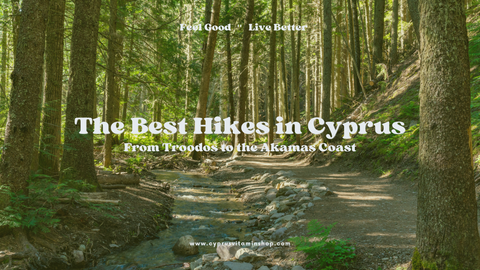
The thing about hiking in Cyprus is that most people discover it by accident. They drive up to Troodos for the weekend, take a wrong turn on a forest road, end up on a marked trail and spend three hours wondering why they haven't done this before.
The island has over 50 mapped nature trails, several genuinely excellent mountain routes, a wild coastal peninsula in the west, and sea-cliff paths in the east that belong on any shortlist of great Mediterranean walks. And outside of the school holiday rush, most of these trails are quiet — sometimes completely empty.
Here's what's actually worth your time, organised honestly.
The Troodos Mountains: the real backbone of hiking here
If you live on the island and you're not going to Troodos to walk, you're missing the best thing Cyprus does outdoors.
Atalanti Trail is the one to start with. Fourteen kilometres circling Mount Olympos at around 1,700 metres, through dense black pine and cedar, with occasional views down into the Solea valley. The altitude keeps it genuinely cool in summer. Sometimes 15°C cooler than Limassol on the same afternoon! You'll earn a good 1,400+ calories burned over four hours, and your legs will know they've been used.
Artemis Trail loops even higher. Around Chionistra at close to 1,952 metres and gives you a long, open ridge walk with panoramic views across the island. At 13 kilometres, it's a solid half-day. The calorie burn here is deceptive because the elevation gain is gradual, but you're looking at around 1,150 kcal for an average person over 3.5 hours.
For something shorter, Caledonia Waterfall is the forest walk that converts people who say they don't like hiking. Three kilometres each way, following the Kryos river through shaded woodland to a 12-metre waterfall. In spring, when the water is high, it's genuinely impressive. In summer, it's one of the few cool, comfortable walks on the island.
Akamas Peninsula: wild, exposed, worth the effort
The Akamas is the last genuinely wild piece of Cyprus. No development, no paved roads in most of it, just maquis and sea cliffs and limestone ridges above some of the clearest water you'll find anywhere.
Aphrodite Trail and Adonis Trail are the two main routes, both starting from the Baths of Aphrodite near Polis. Each covers around 7.5 kilometres with 400 metres of elevation change. They're harder than they look on the map — rocky, exposed, and genuinely demanding in any heat.
This is the important point about Akamas: do not attempt these trails from June to September unless you're up early and finished by 9 am. The scrubland provides zero shade, the terrain reflects heat upward, and the nearest water source is back at the car park. October to May is when these trails make sense. In those months, the calorie burn runs around 420–435 kcal per hour, some of the highest on the island, and the views back across the bay toward the Akamas headland are as good as anything Cyprus offers.
Macheras Forest: the one the tourists skip
Everyone goes to Troodos. Nobody, comparatively, goes to Macheras — which is exactly why it's worth going.
The Horteri Trail at nine kilometres through dense pine, near the cave hideout of EOKA fighter Gregoris Afxentiou, gives you a completely different experience from the mountain routes. It's lower, warmer, and wilder-feeling. The forest is thick enough that you lose the sense of being on an island. You'll burn through 1,200 kcal over three hours and likely see no one else for most of the walk.
Cape Greco: the coastal alternative
On the other end of the island, Cape Greco offers the easiest accessible coastal walk in Cyprus. Six kilometres along the southeastern tip, with sea caves and arches below you and the colour of the water somewhere between green and turquoise depending on the light. It's flat, well-maintained, and spectacular — but there is no shade, and in summer the sun off the limestone path is relentless.
Early morning, late afternoon, or shoulder season. That's Cape Greco. Go at noon in August and it's an unpleasant slog.
What hiking actually does to your body — the numbers
For a 70 kg person at a steady hiking pace, here's a rough guide to what you're burning:
- Easy forest trail (flat to gentle): 280–340 kcal/hour
- Moderate trail with elevation: 380–440 kcal/hour
- Hard mountain route with steep ascent: 480–530 kcal/hour
Cyprus-specific note: summer heat adds a meaningful metabolic load. In August, your body is working to regulate temperature on top of everything else, expect roughly 10–15% higher calorie expenditure than the same trail in October. That's not nothing, but it also means you need to be more careful about hydration and electrolytes. Magnesium and sodium losses through sweat are significant on a long summer hike. Salt your food, consider an electrolyte tab if you're doing anything over two hours, and drink before you feel thirsty - by the time thirst kicks in, you're already mildly dehydrated.
Step count depends heavily on terrain. Smooth tracks average around 1,300 steps per kilometre. Rocky, uneven mountain trails push that above 1,600 per kilometre - shorter strides, more careful foot placement.
A few practical things that are easy to get wrong
Water. More than you think. A litre per hour is the minimum for a warm day on an exposed trail. Akamas especially: there is genuinely nowhere to refill once you're on route.
Start time. Anything coastal or low-altitude from June through August: you want to be on trail before 8 am and finishing before midday. The mountains buy you more flexibility, but midday sun is midday sun.
Footwear. Trail runners or light hiking boots with grip. The limestone sections on Cape Greco and Akamas can be slippery, particularly in the morning with dew. Road shoes are a bad idea on anything above easy.
Sun exposure. Cyprus UV in summer is serious. Factor 50, reapplied. A hat that actually covers your face, not a cap. Vitamin D isn't something you need to worry about if you're spending time outdoors here...but sunburn is!
Where to start
If you haven't hiked here before: Caledonia Waterfall first, Atalanti second. Both are easy to navigate, genuinely beautiful, and give you a proper sense of what the Troodos can offer. Then try Macheras when you want somewhere quieter, and save Akamas for the cool months when you can actually enjoy it.
All calorie estimates based on a 70 kg person. Difficulty ratings follow the Cyprus Department of Forests classification system. Trail conditions can change seasonally - check with the Troodos visitor centres before tackling mountain routes in early spring or after heavy rainfall.