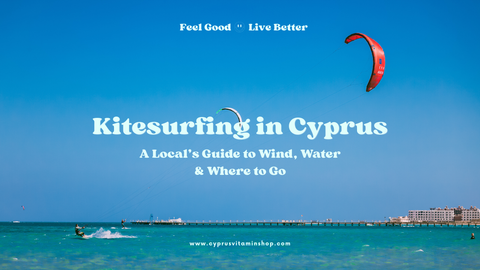
By noon in July, the wind picks up along the south coast like clockwork. It rolls in from the southwest, warm and consistent, and if you're standing on the right beach watching someone launch a kite and tear across flat water, it looks like the most fun you can have on this island. It might be.
Cyprus doesn't have surf in any meaningful sense, the Mediterranean is too enclosed for real swell. But wind? Wind it has. And the kitesurfing scene here is genuinely world-class, not just by regional standards. People fly in specifically for it. The fact that most locals don't know this says more about how quietly the scene has grown than it does about the quality.
Here's what you need to know where to go, what the conditions are actually like, and how your body handles a full day on the water.
The Wind: What You're Working With
The key to understanding kitesurfing in Cyprus is the meltemi. It's a seasonal wind that blows predominantly from the northwest, with average speeds of 15 to 25 knots, and it's most reliable from May to September. That's the core of the summer season — the same months when most people on this island are either at the beach or hiding from the heat indoors.
Summer is the peak season for both sports, with westerly winds blowing strongest from May to October — though there are days during summer that are still and breathless. Check a wind forecast before you drive anywhere. Windy.com is what the local kitesurfing community uses.
Many professional kitesurfers in Cyprus actually prefer autumn and winter, when east winds can blow at 17–23 knots. October through February is underrated if you're experienced and don't mind the cooler water. The spots change — some summer beaches become winter spots and vice versa — but the wind doesn't disappear when the tourists do.
One important practical note: in the summer season you are not allowed to kitesurf on public beaches, so you need to go to the designated kitesurfing spots. There are enough of them that this isn't a problem — but it does mean you can't just show up anywhere.
The Best Spots on the Island
Mazotos / Kiti (Larnaca) — Where Everyone Should Start
This is the island's kitesurfing heartland. The Mazotos/Kiti area near Larnaca has steady, consistent winds throughout the year peaking from May to October, making it one of the best kitesurfing spots not just on the island but in the wider Mediterranean region. That's not marketing copy — it's been validated by people who've kited across Europe and come here on purpose.
The sea here is also safe: no rocks, shallow waters, and no strong currents. That combination — reliable wind plus forgiving water — is why it's the spot most instructors use for beginners, and also why experienced riders keep coming back. Softades Beach at Kiti, home to Kahuna Surfhouse, offers conditions suitable all year round, and is only 10–15 minutes from Larnaca airport. If you're flying in with gear, the logistics are unusually straightforward.
Paramali (Limassol) — The Safest Beach on the Island
Paramali is located between Limassol and Paphos, a couple of kilometres of beach that works best with southwest wind — which is the prevailing summer wind along the south coast. The kitesurfing school based here describes it as the safest beach on the island because of the long stretch of open sand and the absence of obstacles. It sits within the British Sovereign Base Area, which also means no vehicles on the beach and no buildings — it's also a turtle nesting beach, kept deliberately clean. Worth knowing before you go.
Ladies Mile Beach (Limassol) — Winter Waves
Ladies Mile, just outside Limassol harbour, is one of the best beaches for winter kitesurfing. It's not ideal in summer because the wind runs mostly offshore — but when the east winds arrive in winter, it gets real waves. If you're here year-round and want something with more character than flat water, this is where you come once the tourist season ends.
Pissouri Bay — The Scenic Option
Nestled between Limassol and Paphos, Pissouri Bay offers a mix of flat water and small to medium-sized waves against a backdrop of limestone cliffs. It's not the highest-wind spot on the island, but it's one of the most beautiful stretches of coast you'll kite on anywhere. Go for the scenery as much as the conditions.
Pyla (Larnaca) — The Local's Alternative
Closer to Larnaca, kitesurfers and windsurfers also favour Pyla and the Kitemed Beach area, which tends to be quieter than the main Mazotos stretch on weekends. If you want the same reliable Larnaca wind without the crowd that builds up at peak hours in July and August, come here instead.
What It Actually Does to Your Body
Kitesurfing looks effortless when someone experienced does it. It isn't. The kite does the pulling, but your body is working continuously to control it, balance on the board, and absorb chop from the water.
Kitesurfing is a full-body workout: it tones the upper body — arms, core muscles, and lower back — while also strengthening the legs, including quads, hamstrings, and calves. The harness takes most of the kite load off your arms, which is why your hips and lower back get worked harder than you'd expect. Core strength is the thing that improves most noticeably after consistent sessions.
On calorie burn: the range is genuinely wide depending on conditions and intensity. In wind speeds of 12–15 knots, a person weighing around 60kg will burn roughly 600 calories per hour of kitesurfing. French researchers who studied the question found that an average person burns around 750 calories per hour kiteboarding in light wind conditions for comparison, that's similar to a moderately hard cycling session or a slow run. Push the wind up to 20+ knots and you're working significantly harder.
Beginners actually burn more calories than experienced riders, mainly because they spend most of their time walking upwind with the kite, dragging through the water rather than riding efficiently. A two-hour beginner lesson in July heat will leave you more tired than you expected.
Kitesurfing also combines aerobic and resistance elements, which makes it good for cardiovascular fitness; it gets your heart rate up and builds endurance in a way that pure strength training doesn't. And like most ocean sports, the mental side is real: the concentration required to manage the kite, read the wind, and stay on the board occupies your mind completely. There's no room for whatever was stressing you out onshore.
What to Take With You
A day of kitesurfing in the Cypriot summer is physically demanding in a way that creeps up on you. You're working hard, the sun is high, and the wind dries you out faster than you notice.
Electrolytes - non-negotiable
This matters more here than at most spots in Europe. The combination of physical output, heat, and the drying effect of the wind means you're losing sodium, potassium, and magnesium at a serious rate. Water alone won't replace that. An electrolyte supplement taken before your session and again midway through makes a real difference to how you feel in the final hour and how you recover the next morning. If you're getting headaches or cramping up on the water, this is usually why.
Magnesium
The muscles doing the most work in kitesurfing — lower back, hips, hamstrings — are the ones most affected by magnesium depletion. Consistent supplementation supports normal muscle function and reduces the cramping that beginners especially tend to experience. Magnesium glycinate absorbs well and doesn't cause the digestive issues some other forms do.
Vitamin C
A long day exposed to UV and physical exertion generates oxidative stress, more than most people account for. Vitamin C is your primary water-soluble antioxidant and gets used up quickly on days like this. It also supports connective tissue repair, which matters when your wrists, shoulders, and hips have been absorbing load all day.
Vitamin D
You're going to get sun exposure, that's given! But high SPF sunscreen (and you should be wearing it on the water, where UV reflects off the surface) significantly reduces your skin's ability to synthesise Vitamin D. Supplementing year-round makes more sense than skipping sun protection on the assumption you're building stores naturally.
Protein - the one people forget
A two-to-three hour kite session is a legitimate training load. If you're coming back and not eating adequately afterwards, you'll feel it the next day. A quality protein intake post-session, whether from food or a supplement, supports the muscle repair that's happening whether you plan for it or not.
Practical Notes
The wind arrives in the afternoon. In Limassol especially, the thermal wind typically picks up in the afternoon, making late mornings through early evenings the best window. In Larnaca it tends to arrive a little earlier. Check the forecast the night before and plan accordingly — an early-morning drive to a flat-calm beach is a frustrating way to spend a day.
Take lessons if you're new. Kitesurfing with bad habits or without proper safety training is genuinely dangerous — for you and for the people around you. The schools at Mazotos and Paramali are well-run and IKO-certified. A two or three-day beginner course is the right way in.
Autumn is worth considering. September conditions on the south coast are often better than August — the meltemi is still active, the crowds thin out, and the sea temperature stays warm through October. If you have flexibility, it's the best time of year to be on the water in Cyprus.
The wind on this island is one of its most underused assets. Most people spend the afternoons retreating from it — closing shutters, moving to the shaded side of the terrace. The kitesurfing community has figured out a better use for it.