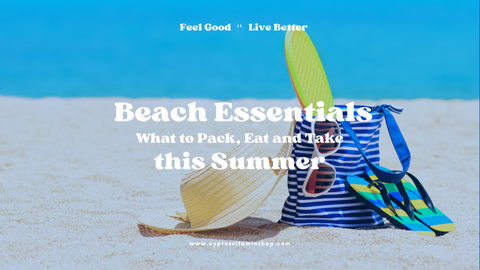
A bad beach day in Cyprus is mostly self-inflicted. You forget water, you underestimate the sun, you eat something too heavy at midday and spend the afternoon flat on your back under a towel. The beach itself is never the problem, Konnos, Lara, Avdimou, Coral Bay, the island has more good coastline than most people get through in a summer. The preparation is where it goes wrong.
This is what to bring, what to take, and what your body is actually doing out there.
What Your Body Is Up Against
Cyprus in July and August doesn't ease you in. By 11am the sand is too hot to walk on barefoot, UV index readings regularly hit 9 or 10 (the "very high" and "extreme" bands), and air temperatures in coastal areas sit between 33°C and 38°C for weeks at a stretch. That combination — heat, UV, humidity off the sea — puts a real physiological load on the body even if you're just lying there.
You sweat more than you think. In high heat, a resting adult loses somewhere between 0.5 and 1 litre of fluid per hour. If you're swimming, playing beach volleyball, or walking along the shore, that number goes up.
The Physical Side: Calories and Activity
People underestimate how much energy a beach day uses. Here's a rough picture:
Swimming (moderate pace): 400–500 calories per hour. The water resistance makes it one of the more efficient calorie-burning activities that doesn't feel like exercise.
Beach volleyball: 300–400 calories per hour. The sand makes every movement harder — your legs work significantly more than on a firm surface.
Walking on sand: 250–350 calories per hour, depending on pace. Soft sand increases energy expenditure by around 1.6x compared to walking on pavement.
Sunbathing (doing nothing): Your resting metabolic rate still burns around 60–80 calories per hour. The heat causes your body to work harder to maintain core temperature, which nudges this up slightly.
A full six-hour beach day with a mix of swimming, walking, and rest could put you at 1,000–1,800 calories burned depending on how active you are. That's relevant when you're thinking about food.
What to Eat and Drink
Water — more than you think you need. Two litres sounds like a lot until you're two hours into a beach day and already feeling sluggish. Three litres for a full day is a reasonable minimum. Cold water absorbs slightly slower than room-temperature water, which is worth knowing if you're drinking fast to catch up.
Food that works in heat. Heavy, high-fat meals slow digestion and make the heat feel worse. Fruit works well — watermelon in particular is about 92% water and has a small amount of natural electrolytes. Sandwiches with lean protein, olives, cucumber, a bit of halloumi. The Cypriot instinct to bring a tupperware of cut fruit is exactly right.
Avoid: large quantities of alcohol during the hottest part of the day. Alcohol is a diuretic — it accelerates fluid loss at the exact moment your body is already losing it through sweat.
The Supplements That Actually Matter in Heat
Electrolytes
This is the one most people miss. When you sweat, you're not just losing water — you're losing sodium, potassium, magnesium, and chloride. Plain water doesn't replace these. When electrolytes drop, you get headaches, fatigue, muscle cramps, and in more serious cases, nausea. An electrolyte supplement — powder, tablet, or capsule — taken with water during a long beach day helps maintain the balance that keeps all of that at bay.
Magnesium
Magnesium is involved in over 300 enzymatic processes, including muscle contraction and nerve function. It's also one of the first minerals depleted through sweat. A beach day in Cypriot summer heat is a reliable way to run your stores down. Taking magnesium in the evening after a day in the sun also supports sleep quality — something the heat itself tends to disrupt.
Vitamin C
UV radiation generates oxidative stress in the skin; essentially, unstable molecules called free radicals that damage cells. Vitamin C is a well-researched antioxidant that helps the body manage this process. It doesn't replace sunscreen, but it works alongside it from the inside. Some research also suggests it supports collagen synthesis, which matters if your skin is taking regular sun exposure over a summer.
Vitamin D
This one is worth flagging honestly: if you live in Cyprus and spend time outdoors, you're probably not deficient. The UV index here is high enough from April through October that most people produce adequate vitamin D through regular sun exposure. That said, people who avoid direct sun (reasonable, especially between 11am and 3pm) or who are darker-skinned — which affects synthesis efficiency — may benefit from supplementing. Worth checking with a blood test if you're unsure.
Zinc
Zinc plays a role in skin repair and immune function. The skin takes real punishment from repeated sun exposure across a season. Zinc supports the repair process and has some mild anti-inflammatory properties. It's not a dramatic intervention, but for people spending a lot of weekends on the beach all summer, it's a sensible addition.
The Practical Kit: What to Actually Bring
Nothing revolutionary, but the things people consistently forget:
Sunscreen, SPF 30 minimum: and reapply after swimming. Water removes it faster than sweat does.
A proper hat: a wide brim is better than a cap for actual sun protection. The neck and ears are where people consistently burn.
A refillable insulated bottle: cold water stays cold for hours and you're significantly more likely to keep drinking if it doesn't taste like warm plastic.
A light long-sleeved layer: useful for the drive home or a walk along the harbour in the evening when it cools down and your skin has had enough.
Cash: a lot of the smaller beach spots and tavernas on the island still don't reliably take card. This hasn't changed as much as people assume.
Timing
The gap between 11am and 3pm is where most of the UV damage happens. Arriving early, by 8 or 9am, gives you the best hours: the sea is calm, the light is beautiful, the beach isn't crowded. Leave or find shade for the middle of the day, then come back in the late afternoon when the sun is lower and the temperature has dropped a degree or two. The beaches are at their best between 5pm and 7pm anyway.
The beach isn't complicated. But your body is working harder than it looks like it is. Get the water right, get the electrolytes right, and you'll feel the difference between a good day and a great one.